Behind the Experience: Wildlife Coexistence Research in Sri Lanka
May 11th 2025
Situated across a stretch of ocean from the southern point of India, in the south-western corner of the Bay of Bengal, is Sri Lanka. It is an island rich in culture, wildlife and beautiful landscapes, and at its heart lies the Wasgamuwa National Park, a haven for biodiversity. Wasgamuwa is home to large herds of Asian elephants, as well as sloth bears, leopards and a whole range of birds. One of Sri Lanka’s lesser-known parks, it is nevertheless very popular with wildlife enthusiasts because of its thriving ecosystem.
Sri Lanka’s human population has increased considerably since the mid-20thcentury. The isolated nature of islands means land and resources are limited, and this can lead to conflicts between individuals or groups of animals with overlapping territories. Human activity is increasingly overlapping with elephant territory in Sri Lanka, often due to development or agriculture projects being allocated land in areas where elephants live.
Human-Elephant Conflict
Where humans and elephants live alongside each other, interactions are not always peaceful. Elephants sometimes raid crop fields, especially if other food sources are less available or accessible. This is a major problem for farmers, who face losing their source of income, however, retaliation attacks and devices used as deterrents can be fatal for elephants. Recent data shows alarmingly high numbers of elephant deaths in Sri Lanka, of which a significant portion were identified as human-caused. It is more common for conflict to result in elephant deaths than human deaths, but still, people are regularly killed in interactions with elephants.
Being a national park, Wasgamuwa has a degree of protection from human development. However, the surrounding areas are major sites for overlap between human and elephant communities.
A Recurring Problem
Both authorities and individuals have tested out a range of responses to the problem. These responses commonly involve creating some kind of barrier around land that is used by humans, to keep elephants out. These barriers come in a range of forms, including conventional fences, loud off-putting sounds such as firecrackers, and armed car patrols. These methods have been criticised as ineffective due to their temporary nature, a lack of collaboration between forest management authorities, and staff shortages in the Department for Wildlife Conservation.
It seems elephants always find their way back to human-inhabited areas no matter what drives them away. A possible explanation for this is that protected areas, which the deterred elephants are often herded into, lack sufficient space and resources for the elephant population.
When deterring methods fail, it is more likely for people to turn to violent responses such as retaliatory shooting, or so-called “jaw bombs” which are hidden in bait to explode when bitten.
Despite the appearance of a large elephant population, records indicate a considerable decline since the 19th century. The Indian elephant, of which the as yet unevaluated Sri Lankan elephant is a subspecies, is listed as Endangered by the IUCN.
As tensions grow, Sri Lanka may have to start re-thinking its elephant management methods. Since new habitat isn’t available and reducing either the human population or elephant population is not an option, research into innovative strategies for coexistence will likely be crucial tool for conservationists.
Volunteer Impact
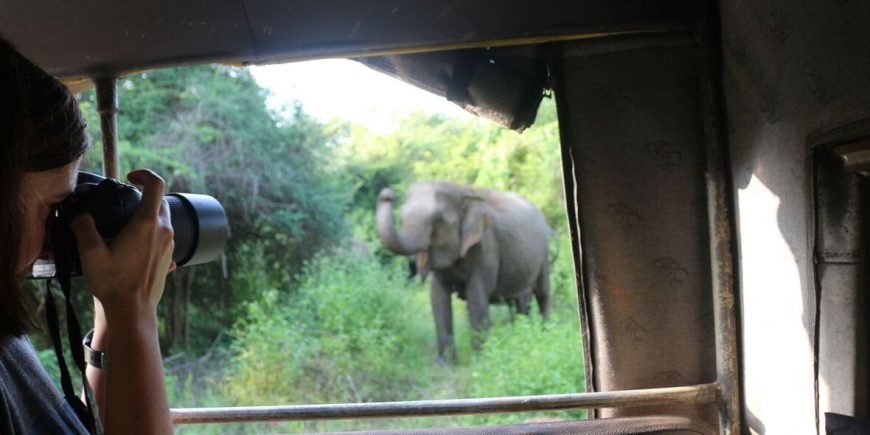
As part of WorkingAbroad’s elephant conservation project, volunteers will be able to take part in data collection that will go towards this important research.
By observing elephant feeding and roaming behaviour volunteers help to keep track of local elephant populations and their habits. Surveys with local communities are also carried out regularly to monitor the occurrence of conflicts. Additionally, volunteers get the chance to help with monitoring and maintenance of some newer barrier methods such as orange groves and bee-hive fences.
Though the project focuses on elephants, there are plenty of opportunities to get involved with other wildlife conservation work. A study on small wildcats, a carnivore research project, and work in the bird, butterfly and dragonfly sanctuary are all on offer too!
Whilst carrying out valuable research and maintenance, volunteers get to experience living in the midst of Sri Lanka’s beautiful and diverse natural landscape and feel a sense of immersion in local nature and culture.



 Human-Elephant Conflict
 A Recurring Problem
 Volunteer Impact