I woke up to a spider crawling across my face. If I were back home, I think I would’ve panicked and flung myself out of bed as quickly as humanly possible. Maybe because I’m getting used to the bugs here (or maybe because I was still half-asleep) I just brushed the spider away and fell asleep again.
Food Shopping as a Volunteer in The Amazon Rainforest
The big news this week is that the shop in Lucerna seems to have stopped selling the aloe drink that I like. It’s probably just out of stock. I’ve switched to small cartons of peach juice for the time being, but they’re just not the same.
Aside from picking up the weekly ‘pedido’ (the food and other supplies to be collected), there was another task to be completed in Lucerna this week. One of the local dogs recently had puppies, all of which needed to be vaccinated. After buying our snacks (and some disappointing peach juice), we sat down on the plastic chairs around the little table outside of the shop.
Amazonian Puppies
Puppies rolled around in the dust beneath our feet. Picking up one of the smallest, fluffiest puppies, which had taken its place beneath my chair, Sam handed it to me with the words “This one has chosen you.” Each of us was to hold a puppy until they had all been vaccinated so that none of the puppies were accidentally vaccinated twice. While the other puppies could be seen squirming around in people’s arms, ‘my’ puppy sat calmly in my lap while it received its shot. It remained there until it was time for us to leave.
Many people are surprised when I mention that I’ve never had a pet before. I’m a zoologist, after all. When I was younger, every year I would write to Santa asking for a dog. It wasn’t until I was older that I understood that we didn’t really have the time commitment or the space for a dog. I think I’d like to have a dog someday in the future though. Though I hope it won’t be quite as mischievous as Josie, who still steals our shoes regularly!
The Rainforest has its name for a reason!
Back at the research centre, we were all chilling after lunch, when it started to rain. As it’s currently the dry season, it hasn’t rained much during my time here. When it rains, it pours. As the walls of the research centre are simply made of mosquito netting, we were instructed to move our electronics away from the walls, where they could get wet.
Suddenly, there was a flash of light and a loud crack which made everyone jump and made Josie howl in fear. “Was that lighting?” I asked. Maria started laughing at me. “Yeah, that was lightning,” Dylan confirmed, I think surprised that I had to ask. “It could have been an electrical explosion or something,” I said to no one in particular. I’d never seen lightning that close before.
This Week’s Wonderful Amazon Wildlife
The best time to spot wildlife on night walks is after it rains. We’d been unsuccessful in finding snakes the past few times and were hoping that the rain would change things. “I see eye-shine!” Maria announced. “It’s probably just a moth,” Vicente ventured as usual. Despite what Vicente says, when Maria spots something, it usually isn’t just a moth. She has spotted birds, opossums, and even Amazon tree boas! This time, it was a water droplet on a leaf. “Oh,” Maria laughed.
Further along the trail, Vicente spotted a frog. “It has something on its back, what is that?” He peered at the frog, inspecting it more closely. I was wondering if the frog might be carrying a baby on its back. Not all frogs begin life as tadpoles. There are many ways in which frogs can develop. In some species, the eggs are laid on the female’s back and skin grows around the eggs. The baby frogs then hatch out of the female’s back. But that wasn’t the case this time. “It’s a snake!” Vicente exclaimed. “There’s a snake eating the frog!”
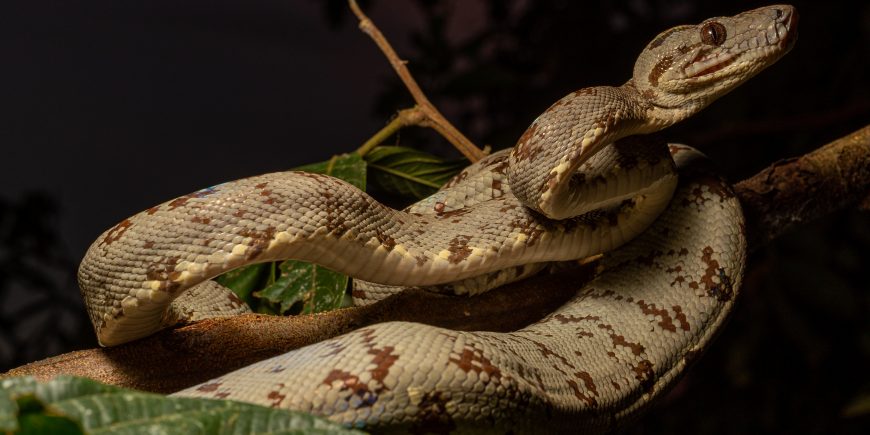
During my time here, I’ve seen 6 different kinds of snake and one that I wasn’t able to identify. These included a coffee snake, a calico snake, two Amazon tree boas, a velvety swamp snake (known here as pineapple snake), a blunt-headed tree snake and a cat-eyed snake. The most dangerous snakes here are the bushmaster and fer-de-lance, which we haven’t encountered yet.
Fighting Wasps
While we’re busy taking photos of the animals we spot on the night walks, we’re ambushed by the night wasps. Active at night and twice the size of a regular wasp, these villains are drawn in by the light from our headlamps. They often send us sprinting away down the trail.
We’ve come to call one of these trails ‘the wasp trail’, where both Maria and Vicente were stung. Maria appears to be collecting insect stings. Surprisingly, she described the night-wasp sting as even more painful than the bullet ant! Although she mentioned that the pain from the bullet ant sting lasted longer. She jokes about being stung by a scorpion next.
A Birthday in The Amazon
On Sunday, I celebrated my 22nd birthday! Maria made breakfast and Justine, one of the new interns, offered to wash my dishes. Sam and Dylan made an amazing pad thai and a berry cake. It’s a Peruvian birthday tradition to have your face plunged into the birthday cake. I think Sam was feeling a little apprehensive about doing that to me because she only dipped my chin into the icing. Out of the corner of my eye, I saw Julio on his way over to slam my face into the cake, but he didn’t get there in time. Overall, it was a very nice birthday.
If you’ve enjoyed reading this (I hope you have) you can follow my blog.



 Amazonian Puppies