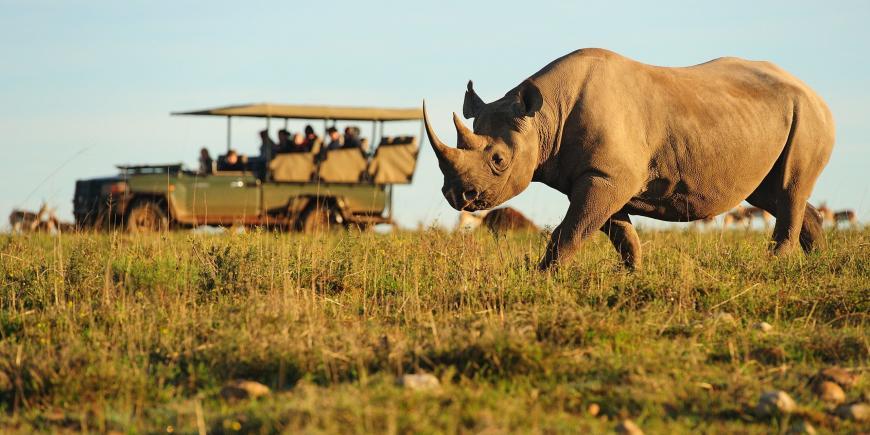
It’s no secret that the future of rhinos is pessimistic. Three of the five remaining rhino sub-species are endangered (the Sumatran, Javan and black rhino), one is classed as vulnerable (the greater one-horned rhino) and one is near threatened (the white rhino, with northern and southern sub-species). The northern white rhino is extinct in the wild, and only two females remain on the planet after the last male died in 2018. As such, the preservation of the northern white rhino appears impossible.
However, BioRescue is an organisation tasked with developing and using advanced reproductive technologies to save critically endangered mammals from extinction. The German Federal Ministry of Education and Research is funding a project to develop methods of assisted reproduction and stem cell experimentation to help save the northern white rhino under the guidance and expertise of Leibniz Institute for Zoo and Wildlife Research.
Back in 2015, a group of international scientists met in Vienna to establish a strategy to save the northern white rhino. They developed an approach combining advanced assistant reproductive technologies (ART) and stem cell associated techniques (SCAT), state-of-the-art technology that uses biomaterial of live and dead animals through cryopreserved gametes. This offered a glimmer of hope for establishing a self-sustaining and genetically healthy population of the northern white rhino, despite the only two remaining being unable to carry a calf.
Biological breakthrough
Back in January, scientists had a huge breakthrough in using this technology after successfully transferring a lab-created southern white rhino embryo into a surrogate to achieve the first ever rhino IVF pregnancy. Southern white rhinos are closely related to their northern cousins and will be essential in helping save the latter from extinction.
The surrogate became impregnated after 13 attempts of IVF, but tragically died of an unrelated bacterial infection 70 days into her term. Scientists had collected southern white rhino egg cells from a rhino in Belgium and combined them with sperm retrieved from the same species in Austria, before fertilising them in vitro in Italy and transferring the embryos into the surrogate in Kenya.
This successful case in the southern whites has renewed hope for saving their northern counterparts. But resources are limited as only 30 northern white rhino embryos exist, harvested from the eggs of the remaining females and sperm preserved from Sudan, the last northern male. Rhinos are vast animals and a female’s reproductive tract is nearly two metres long, making inserting an embryo extremely challenging. IVF across sub-species has never been attempted before, so scientists are working with experimental techniques throughout the process.
A southern white rhino surrogate has been identified to receive the northern white embryo. All that is left now is to wait for optimal fertility conditions and let nature (and technology) take its course.
Genetic modification
BioRescue hopes to later expand the northern white rhino’s gene pool by re-engineering skin stem cells (extracted from preserved tissue samples) into sex cells. Biologists would combine these lab-engineered sex cells with natural sperm and eggs to create embryos, which would then be inserted into southern rhino surrogates. Reprogramming stem cells like this has produced healthy offspring in lab mice, so optimism is not unfounded. But the genetic make-up of rhinos is extremely different, and the animals are hugely understudied in comparison.
If the embryo transfer is successful and northern white rhino calves are born as a result, they will not be genetically diverse enough to sustain a viable population. Researchers would need to use gene editing to expand the genetic diversity of the animals, taking genetic material from the skulls of those preserved in museums to avoid inbreeding and its biological consequences.
The rhinoceros family has been traced back 50 million years to when the woolly rhino existed in cold, dry climates. Back then, the diversity of the species was far beyond the mere five we have now, whittled down by hunting and changing climates. The poaching crisis in the 1970s and 80s wiped out northern white rhinos in Uganda, Central African Republic, Sudan and Chad, driven by demand for rhino horns for use in traditional medicine and ceremonial weaponry. As a result, we are left with a diminished population that we are so desperately trying to bring back from the brink of extinction.
There is a certain, tragic irony in being reliant on man-made technology and human intervention to fabricate one of the most natural things of all, reproduction. Particularly when it is man-made consumerism and human greed that has threatened the species with extinction in the first place. Perhaps, one day, we will learn from our mistakes. Until then, we can only hope that our scientific compensation is enough to reverse the damage that we have inflicted upon the natural world.
How Can You Help Rhinos?
Here at WorkingAbroad we have a number of projects that work closely with Rhino species to try and save them all from the threats they face to their survival. Our projects in South Africa are especially great for helping protect Rhinos from extinction, where volunteers can work on reserves to research and monitor the species.
Written by WorkingAbroad Blogger Gemma Howard-Vyse



 Biological breakthrough
 Genetic modification