Nature Restoration in Bali: Finding Hope Among Ruins
August 4th 2024
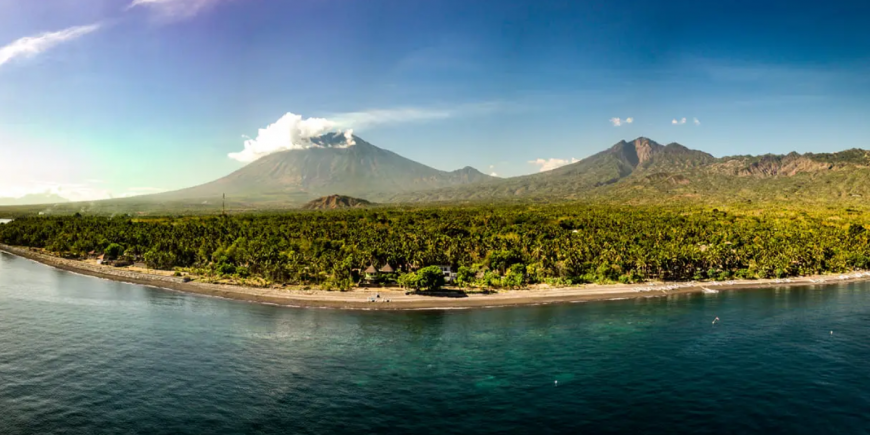
I recently concluded a two month trip around Bali, and although I did anticipate enjoying life on the island, I truly did not expect to fall in love with it to the extent I did. Life in Bali felt easy, with an abundance of tropical fruits (papayas, dragon fruit, bananas) to hand at all times, countless stunning beaches, warm and hospitable locals and a culture shaped by religion, spirituality and daily rituals that give meaning to each moment.
In the south of Bali, you will be greeted with ‘om swastiastu’ which means ‘God bless you’, and in some areas along the west coast where Muslim cultures preside alongside the Hindu community, the greeting becomes ‘salamun alaykum’, meaning ‘peace be upon you’ in Arabic. This, to me, exemplifies the sense that every small moment in Bali has its meaning, as though there is a higher purpose to life on earth.
As you drive up and down through Bali’s rich green valleys and mountainous roads, you will see trees adorned with cloths, with sweetly smoking incense wafting heavenwards from their bases, as offerings to the Gods. When golden hour hits, the people themselves appear to glow, giving the impression that there truly is a magic here that transcends this realm.
That being said, this society is not without its challenges – and this is especially true where nature conservation is concerned.
Nature isn’t free here
Somewhat paradoxically, the thing that enables me to love travelling in Bali is also the thing that frustrates me about this island, which is the fact that in some ways nature isn’t free. Unlike in England, tourists must pay to enter a national park or a protected area in Bali – this is government regulation, and includes the cost of a not-so-cheap guide.
Whilst this frustrated me in moments of my trip, I also appreciate that this tourist economy is the main reason why Bali is one of the better off islands in the Indonesian archipelago, allowing efforts to go towards nature restoration, cultural preservation and the many tours and opportunities that tourists can enjoy. It’s also simply more pleasant to travel in a place that isn’t beset by poverty, and where the standard of living allows the rich and historic Balinese culture to continue to shape traditional lifestyles.
Plastic on the Island of the Gods
Whilst it’s true that Bali, as the ‘Island of the Gods’, must be one of the most beautiful places on earth, it’s also an undeniable fact that this small Indonesian island nation is facing devastating impacts of climate change. This is happening at an alarming rate, and in a way that is much more visible than in many parts of Europe. You can’t look away from it here – there’s no burying your head in the sand, when the sand is littered with layers of plastic.
Initially wondering if the plastic was disposed of on the beaches, I quickly learnt that instead it fills Bali’s inlets and rivers, washes out to sea with the rain, and is later brought back onto the island’s once-pristine shores by incoming tides. I’ve seen local efforts to pick up the rubbish and pile it onto wheelbarrows, but it’s like removing a needle from a hay-stack. I can only imagine the patience required to keep trying despite the never-ending nature of the problem. Nonetheless, where there is a will, there is a way, and I am continuously impressed by efforts to change this – however small steps they may be.
Exploring the Culture
Towards the end of my trip I spent over a week in the west coast of Bali, where there are less tourists, more wilderness and rain, rice fields as well as an interesting mix of Muslim and Hindu cultures. On my first day there, I motorbiked down to the main tourist attraction in this area – the famous point break of Medewi, where peeling left-handers break off not-so-friendly rocks and a reef.
Once there, a local man on a scooter came over to me with a laminated sign, advertising his surf-themed t-shirts for IDRP 200k (about £10) each. In return, he uses the money to fund a beach clean up that he conducts every weekend. If I doubted his legitimacy, I thought the best evidence was the beach itself, which up until the fishermans boats was clear of the plastic that so often characterises Bali’s shores.
Coral graveyard
Despite Bali being a tourist hotspot amidst the 7000 inhabited islands of Indonesia, I’m forever on a mission to find the less-traversed areas. That’s why I chose to visit Gili Asahan, one of 14 tiny islands in the southern archipelago of Gili (as opposed to visiting the better-known northern islands of Gili Trawangan, Gili Meno and Gili Air).
I naively expected Asahan to be as naturally pristine as its lack of tourism indicates, but of course, we live in 2024, and climate change is inescapable even on earth’s remotest corners. Surprisingly, and sadly, I came across what can only be described as a coral graveyard, with the white sandy beaches decorated with the bones of dead coral as though the island itself was calling out to us to save its surrounding waters.
In a way, the coral is itself beautiful, and doesn’t take away from the island’s peaceful and serene nature, possibly even adding more character to their perfection. It doesn’t interrupt the sense of it being a calm oasis from the rest of the world, but it did lead me to wonder if action was being done to restore this. But luckily there are projects at WorkingAbroad that are fighting this battle!
Hope amongst the ruins
I assumed restoration efforts may be focused on the famous Gili Islands, but instead stumbled upon a coral-restoration project in a harbour town that is bringing a new underwater life to Bali’s eastern shores. Padang Bai, on Bali’s south-east coast, is where the fast and slow boats leave to Lombok, and where locals make a living from fishing and tourist endeavours such as ad-hoc taxi services and snorkelling and diving tours. Since 2019, local jobs have now been created in coral restoration, thanks to Livingseas dive center.
You can purchase a sea-star (a steel structure with resin, sand and 18 live coral fragments attached) from Livingseas for IDR 400k – the equivalent of £20. It’s a fair price to pay for a fun afternoon activity and some relief from the ever-all-consuming climate anxiety. The star is placed on the bed of the ocean, and the coral then continues to grow around it, eventually concealing the star entirely with live coral reef.
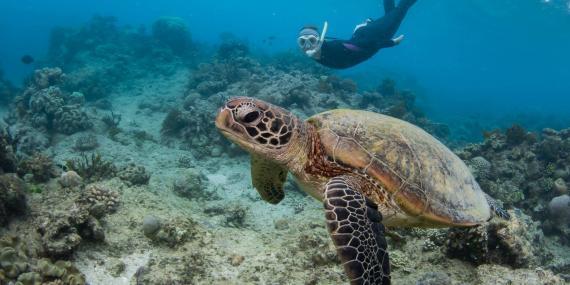
Amazingly, we later decided to snorkel at Blue Lagoon beach, a 10 minute walk from the dive centre, and unlike on Gili Asahan we experienced an entire world thriving beneath the ocean waves. On mini coral islands, fish of all colours – bright blue, yellow, black and white striped – swim in and out of their reef homes, creating a spectacle that would be breathtaking (if you weren’t already holding it).
After these experiences, I left Bali with hope in my heart, feeling that all is not lost. If an entire beach and its neighbouring lagoon are thriving, just imagine how much more we can do – how much restoration humanity is capable of. We have the ability to reconstruct, as well as to destroy, and Bali is a living breathing example of this.
How you can help
If you’re thinking about visiting this beautiful, charming and historic island and want to contribute to nature restoration efforts in your own way, you can take part in Working Abroad’s Coral Reef Restoration & Diving Project.
Set amidst the scenic Eastern shores of Tulamben – a small fishing village and popular diving site north-east of Ubud (Bali’s cultural centre), the project is designed to be four days on with three rest days, allowing plenty of time to travel anywhere and everywhere in this majestical island. As part of this project, you will help construct and deploy artificial reefs, dive up to 8 times a week to monitor progress, and be a part of restoring Bali’s beautiful coastal ecosystems.
I fell in love with Bali more and more each day, throughout my two month adventure that took me to almost every corner of the island I came to call home. I just hope (and the importance of hope cannot be understated) that we can collectively pull together to mitigate the devastation these small islands face before they are lost forever to the rising tide of single-use straws, plastic cups and foam spoons. It’s certainly time we found an alternative way to drink a coconut, that utilises nature’s own packaging, and doesn’t leave a trace.




 Plastic on the Island of the Gods
  Coral graveyard
  You can purchase a sea-star (a steel structure with resin, sand and 18 live coral fragments attached) from Livingseas for IDR 400k – the equivalent of £20. It’s a fair price to pay for a fun afternoon activity and some relief from the ever-all-consuming climate anxiety. The star is placed on the bed of the ocean, and the coral then continues to grow around it, eventually concealing the star entirely with live coral reef.
  How you can help