
Marine and Coral Reef Conservation in Bali
Our reef restoration programme uses artificial reefs to restore areas of exploited coral reefs. This is done by allowing coral larvae to naturally settle and grow in the sandy areas where they otherwise not be able to. These artificial reefs are also designed to incorporate complex habitats for fish and can quickly turn a barren underwater desert into a bustling reef fish community once more.
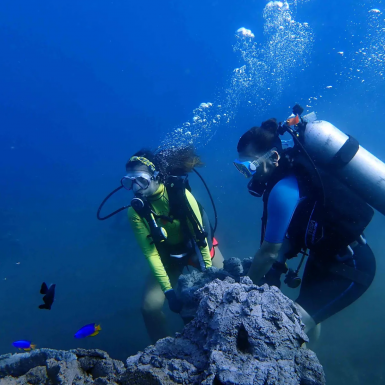 Many areas along the north east coast of Bali have been exploited in the past and are struggling to recover, although these sites still have great potential for restoration. We focus on four sites along the coast and closely collaborate with the local communities in each area to restore the coral reef communities using artificial reefs.
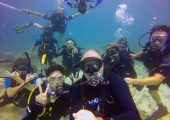
Conservation divers are essential to our reef restoration effort. We dive twice at each of the four restoration sites each week to deploy the artificial reefs alongside members of the local community.
- In the mornings, conservation divers in their dive buddy teams arrange the artificial reef structures into the optimum formation. This is to maximise the habitat available for fish recruiting to the new reef.
- After the deployment dive, we take a short surface interval. This is before our second dive to survey the coral and fish communities, developing on the artificial reef aggregations.
- In the afternoon, we debrief and evaluate the results of our reef monitoring. We work together to develop our coral and fish ID skills as a team. The new data from our reef monitoring programme is entered into our database and shared with local authorities and interested researchers.
Scuba Diving
We aim to dive up to eight times per week. It is therefore required that divers have at least a PADI Open Water Diver (OW) certification. We do offer PADI certification courses at our dive resort. Uncertified divers can complete their Open Water diver course either before or during their first week at an extra cost (£310 GB pounds).
We run PADI OW courses beginning on Friday and finishing on Sunday or Monday to Wednesday. Generally, divers choose to complete their OW course alongside the coral reef restoration programme and this is quite useful for us. If they are here learning throughout the week, they can also join our fish and coral ID workshops. Here, we identify what we have seen on the dives earlier that day.
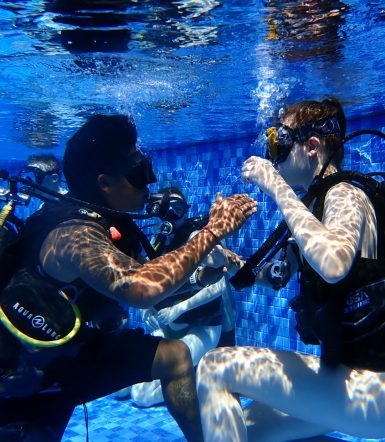
After a week of preparation, they will be more prepared to help with our survey efforts in the following week(s). Since the course only takes three days, they will be able to join us for our final dives on Thursday. We find this a great way to celebrate finishing the OW course.
One thing we are really keen to do is to make sure that divers, who are interested in any of our PADI courses, receive their online e-learning package before they arrive. That way they can complete it before they arrive, and only need to focus on the diving once they get here. For that, we will need them to book and pay for the PADI course in advance. They also need to provide us with some personal information to process their PADI forms.
The coral reef restoration programme starts on Monday morning and finishes on Thursday afternoon. Friday, Saturday and Sunday are free to travel and explore the beautiful island of Bali at their leisure before starting again on Monday. Programme participants should arrive each week on Sunday. They are welcome to stay until their last Sunday, but most will choose to leave on Friday morning.
Restoration Programme Activities
Artificial Reef Deployment Dives
In the mornings after breakfast, conservation divers in their dive buddy teams arrange the artificial reef structures into the optimum formation to maximise the habitat available for fish recruiting to the new reef. We all descend together as a group before swimming to our deployment site. There, we take off our fins and work in buddy teams to carry one structure per buddy team. We shuttle back and forth, adding the newly deployed structures to our artificial reef aggregation.
 Reef Monitoring Dives
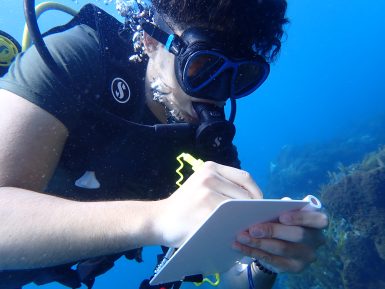
After the deployment dive, we take a short surface interval before our second dive to survey the coral and fish communities developing on the artificial reef aggregations. Here we split into teams with one focusing on our fish surveys and the other focusing on our coral surveys. The fish survey team will work on identifying and counting the species and number of individual fish on the artificial reef. Meanwhile, the coral survey team will help set up our underwater quadrats so we can photograph the coral communities growing on the artificial reef to quantify coral percentage cover, biodiversity and colony size.
Data Processing and ID workshops
In the afternoon, we debrief and evaluate the results of our reef monitoring. We work together to develop our coral and fish ID skills as a team by identifying the unknown individuals recorded on our dives. The new data from our reef monitoring programme is inputted into our database and shared with local authorities and interested researchers.
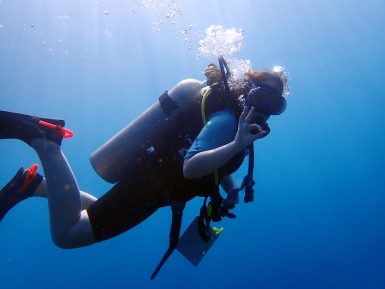 Conservation Diver Training
Our programme is based at a registered Conservation Diver Training Centre. All participants will have the opportunity to earn Conservation Diver’s base level certification (Coral Reef Ecology & Monitoring) as part of our reef restoration programme, provided they can meet the prerequisites.
The coral reef ecology and monitoring course is an introduction to Conservation Diver’s Ecological Monitoring Programme. This is designed to develop a diver’s understanding of the coral reef ecosystem and equip them with basic scientific diving skills. It involves some introductory marine ecology lectures, followed by a survey dive.
Those who wish to further develop their learning and understanding can optionally complete the full Ecological Monitoring Programme (EMP) and progress onto Conservation Diver speciality courses. All courses can either be completed alongside our coral reef restoration programme, or during your free time outside of the programme.