
Useful Information About Kenya
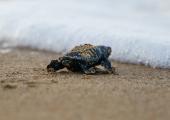
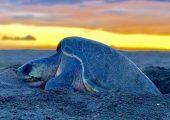
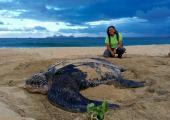
The video below shows Leatherback sea turtle nesting on the project. Leatherback turtles migrate through Kenyan waters but do not usually nest. This is possibly the first recorded sighting of a nesting leatherback turtle on Kenya’s beaches.
Background Information
The Watamu Marine Park is part of a United Nations Biosphere Reserve and has been designated as a place of great natural beauty with miles of beautiful beaches and corals rich in marine flora and fauna.
Watamu / Malindi Marine Parks and Reserve (WMMPR) covers an area of 229 square km and is part of a United Nations Biosphere Reserve, that also includes the Arabuko Sokoke Coastal forest. The WMMPR protected areas consist of two Marine Parks: Malindi in the North, and Watamu in the South. This amounts to approximately 30kms of coastline, with a fringing reef along its entirety, as well as numerous patch reefs. The fringing reef forms several lagoons, some of which are still rich in coral and fish species. The Parks and Reserves provide an important residing and feeding habitat for sea turtles, while the 5km beach within Watamu Marine Park is a key turtle nesting ground in the country. Watamu Turtle Watch was formed in 1997 to continue and develop the marine turtle conservation efforts of a local naturalist Barbara Simpson, which she had been undertaking in the area since the 1970’s. Very quickly they came to realise that the survival of the marine turtles in Watamu was intrinsically linked to the well-being of the surrounding marine environment and to the protection of turtles across their migratory range.
Concerned by the widespread degradation of the Kenyan marine environment, and national exploitation of marine turtles, they broadened its conservation efforts to encompass these issues while maintaining a focus of its turtle activities in the Watamu / Malindi area. They work in close co-operation with the Kenya Wildlife Service (KWS), Fisheries Department, Kenya Marine Fisheries Research Institute (KMFRI) and the Kenya Sea Turtle Conservation Committee (KESCOM), of which it is a member.
In February 2013, the work of the project was featured in the last episode of a 6 part BBC documentary series featuring Sir David Attenborough. You can view the episode here: http://www.bbc.co.uk/iplayer/episode/b01qmbqn/Africa_The_Future/