
Food, Lodging and Travel
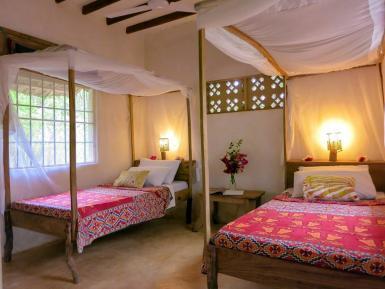
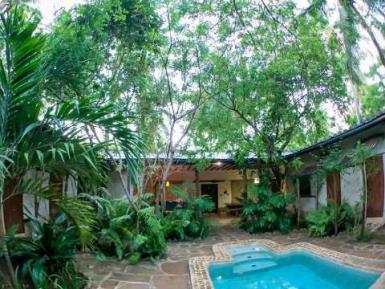 You will be living in a very nice new and clean building, which is called Lallies House. It has a capacity of eight and volunteers share two to a room with each room having an ensuite (toilet, sink and shower). If there are only 4 volunteers, then you have a room to yourself. There are also two large outdoor covered living areas and a communal dining area and a large communal kitchen (including fridge and microwave). The house is located on the same plot as the main office and turtle rehabilitation centre and has good security, a small plunge swimming pool and is about a 5 minute walk to the beach. There is also electricity and running water.
The volunteer accommodation is self-contained and volunteers cook for themselves or can eat out. Weekday lunchtime meals are included in the volunteer fees. Imported food is expensive but there is an excellent selection of fresh fruit, vegetables, fish and meat available in the village at very reasonable prices. There are also many eating options available in the village if you would like to eat out, ranging from international style restaurants to inexpensive roadside grills.
Travel to Watamu
The best and cheapest way to get to Watamu is to fly to Nairobi and then take an internal flight from Nairobi to Malindi. You can book internal flights with Air Kenya, Fly540 or Kenya airways through most international travel agents. You will then be collected from Malindi airport if you arrive on a weekday between 9 to 4 PM (as we have staff available for pickups then). Flying directly to Mombasa international airport is another option but it can be more expensive with the additional hassle of a 2hr taxi drive from Mombasa to Watamu. Details of other transport options (Bus, train, Matatu and car hire) between Nairobi and Mombasa (overnight train, bus, luxury mini-bus), and Mombasa and Watamu (bus, matatu, taxi) can be found in guide books such as the Lonely Planet Guide to Kenya, and Kenya on a Shoestring.
Type of volunteers needed
You should be 18 years old and over, fit, healthy and capable of carrying out manual work in all conditions in a hot climate. No specific skills are needed, but those with previous experience of sea turtle monitoring, conservation work, community development projects etc. would be particularly useful, as well as those who are self-motivated, as you will get more out of the project if you are. We are also looking for volunteers who can take their own initiative, and who don’t always need to be told what to do, and who work well in a team. The project will especially appeal to those with an interest in marine biology. Anyone with additional skills, such as arts and creativity, languages and education are especially welcome.
Volunteer supervision
You will have regular interaction with the Volunteer Coordinator, who will be your supervisor and is usually available on a daily basis. Other members of staff will provide support and training depending on which activities you find yourself participating in.
The locality
When you arrive in Watamu we will provide information on the location and types of local amenities. Below is a summary of what you can expect.
Local Attractions
We recommend you refer to a good guidebook, such as the Lonely Planet or Rough Guide, for descriptions of the area and especially for Kenya as a whole. Such guidebooks also provide an excellent insight into local culture and practicalities.
The Watamu area is part of a United Nations Biosphere Reserve, and so is an area of great natural beauty. There are miles of beautiful, mostly quiet, beaches with safe swimming. The coral reef is rich in marine fauna and flora, and offers excellent snorkelling and diving opportunities. There is also a whole array of watersports available in the area, as well as glass-bottom boat trips and deep-sea sport fishing. Mida Creek a lovely area for interesting walks amongst the mangroves, boat trips and birding.The Gede ruins are some of the oldest in the country and are beautifully set in dense forest. The Kipepeo Butterfly Farm next to the Gede Museum is a very interesting project aimed at encouraging sustainable use of forest resources. Arabuko Sokoke Forest is the largest remaining tract of indigenous coastal forest in E Africa. It is also the second most important forest in terms of biodiversity and endemic species in the whole of Africa! There are lots of nature trails here and also a tree house.
Watamu village and amenities
Watamu itself is small village functioning primarily as a fish landing site and tourist area. There are 7 major hotels in the area, mostly concentrated at the northern end of the marine park. Most of these operate as small-scale, package style, club operations. The local people of the area are mostly of the Christian Giriama or Muslim Bajuni tribes. There is a good array of shops in the area to cater for food shopping and medical needs. There are also internet facilities, local style eateries, tourist restaurants, and 2 prominent African bars/discos. Anything you can’t find in Watamu you will be able to find in the much larger town of Malindi (20kms to the north). Malindi is also the hub for tourism and transportation in the area and has a regional airport. The city of Mombasa is approx. 2 hours to the south by bus. Visit https://en.wikipedia.org/wiki/Watamu for more information about the Watamu area.
Transport
The project has a small Suzuki 4X4 vehicle for project activities and Watamu is well serviced by public transport (“matatus” and busses) to Malindi and Mombasa.
Communication
There are international telephone services available in Watamu, as well as internet services, though these are cheaper in nearby Malindi. The project is unable to provide internet service.
Weather
It is never cold in Watamu so basically bring clothes for a beach holiday. There is a rainy season April-July, which means that some days we may get a few hours of rain (if you come in this time a light raincoat would be useful). It can get chilly on the beach at night with the wind, so it is advisable to bring a couple of light sweaters.
Medical Considerations
The medical facilities in the area are basic but adequate for all but the worst accidents. In event of bad accidents and severe illness, Mombasa has a good hospital and there are very good medical facilities in Nairobi. Visit your local doctor at least a month before you come to Kenya to get all your necessary vaccinations. They will be able to advise you on what is required. Malarone is a common anti-malarial used by volunteers.
Visa Requirements
Volunteers need to come in on a normal 1-3 month tourist visa (they are normally multiple entry and will also get you into Tanzania and Uganda ) – they cost 50 USD (need to be paid in US Dollars, Euros or GB Pounds – USD is best for airport and they won’t have change.) For most countries they can be bought at the airport when you arrive, however we would advise checking particularly if you come from a smaller country.